


A Summer of Experimentation

Artist Residency with Central Artist Corner, located on the first floor of the Fulton County Central Library in Atlanta, GA.
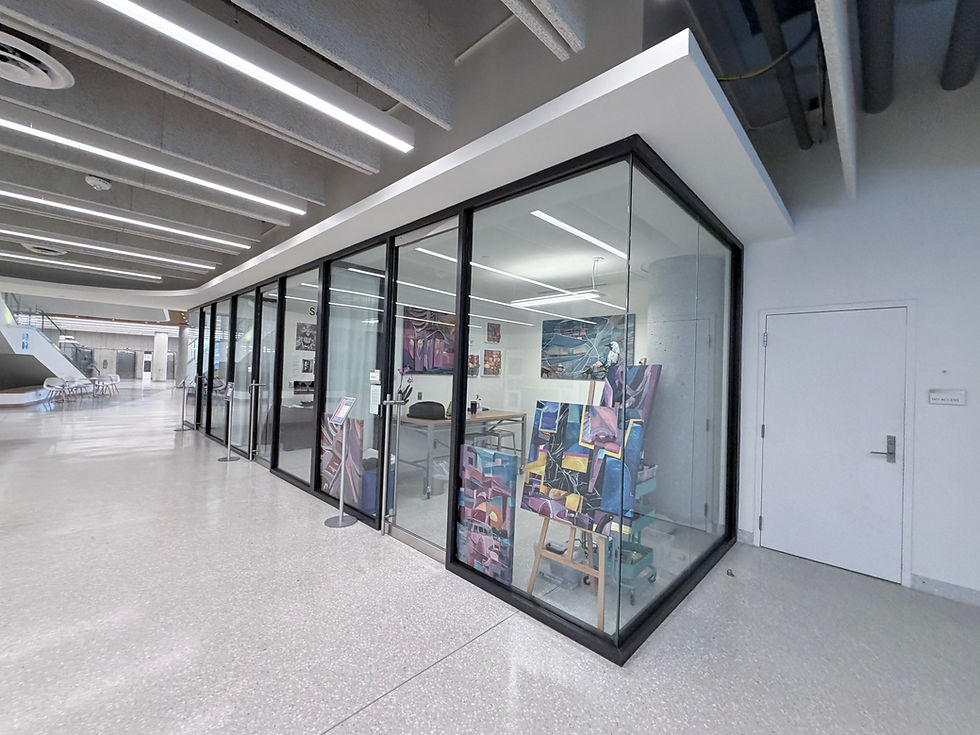
View of Studio C
I just completed a three-month studio residency for Central Artist Corner with the Fulton County Library System | Central Library Headquarters from June 8 through September 8, 2026. Artists in this program are given a public-facing studio space to exhibit work and engage with visitors. I chose to use my residency as an opportunity to create new work while allowing the public an intimate view into my process and studio practice. Over the course of three months, I created 16 new works, including soft sculptures and several large-scale canvas paintings. The residency gave me dedicated space and time to experiment, expand my practice, and push my work in new directions while sharing that process with the community.
During my time in Studio C, I chose to focus on two evolving series: Bioforms and Woven. Bioforms consists of contemplative works on paper and canvas, influenced by patterns found in microscopic biofilms, natural systems, and the nascent stages of life. Woven is a series of soft sculptural reliefs informed by aerial views of patchwork landscapes, prompting viewers to consider the materials and processes underlying their construction. Collectively, these tactile works explore texture, perception, vulnerability, and resilience.
During my residency, the library conducted an interview exploring my artistic process, educational background, and creative influences. I encourage you to view this interview for some insight into my process: Central Artist Corner presents Krista M. Jones.
This residency allowed me to spend the summer experimenting, expanding ideas, and testing what might be possible. One of the works that emerged from this process, Coming into View, consists of nine panels of my woven forms that come together to create a pixelated self-portrait.
The piece served as a proof of concept, allowing me to test whether the individual sculptural forms could function as fragments of a larger image. It also opened the possibility of creating these works at a much larger scale, structures that may initially appear abstract up close but gradually come into view as the viewer moves farther away. Coming into View became an important step in understanding how Woven could expand beyond individual objects into larger, immersive works that shift with distance and perspective.
Photos of Coming into View
During my final month I spent most of my days working from Studio C and found myself returning to painting. This was an unexpected but welcome shift that gave me the opportunity to experiment with how I could expand my canvas body of work.
Within that month, I created four new paintings using a process I am calling Painted Collage. Like my earlier MESO series, these works revisit imagery from previous paintings, but through a different process of deconstruction and reconstruction. I digitally break apart elements of my existing work, rearranging and layering cutout fragments to create an entirely new composition. I then translate that digital collage back into a physical painting by hand.
This process allows me to revisit my own visual history while changing its context. Familiar forms become fragmented, shifted, overlapped, and reassembled into something new, further abstracting the original imagery. The resulting paintings retain traces of where they began, but those images are no longer fixed. Instead, they become material for exploring new relationships, perspectives, and ways of seeing. While this is just the begining of this new direction, I'm excited about its possiblities.
My work reflects how I believe we experience reality, memory, and our lives - in fragments. We are constantly piecing together experiences, memories, emotions, and sensory information to make sense of ourselves and the world around us. This is why each human experience is complex and uniquely their own. Through fragmentation and reconstruction, I am exploring what it means to be human within that complexity.
I have a deep need for predictability and structure, yet life itself is inherently unpredictable. Because of this, I intentionally create ambiguity in my work. In some ways, the process becomes a way of controlling ambiguity: I construct a space without a single fixed interpretation, allowing multiple possibilities and perspectives to exist at once.
New works within Painted Collage.
This residency also became an unexpected social experiment. Studio C is essentially a glass box, and I made an intentional decision that my presence there would be no different from how I exist in my private studio. There was no performance for the public. Visitors were literally looking into my studio practice and everything that involves.
Some days that meant they saw me actively making work. Other days they saw me reflecting, staring into space, crying, or simply sitting with an idea. These are all real parts of the creative process that are usually hidden from view.
At the same time, I was watching the people outside as much as they were watching me. The glass began to feel like a thin membrane between us, separating my private creative world from the public space around it while still allowing each side to see the other.
I became particularly aware of this boundary when I invited people inside. After spending so much time and pouring so much energy into that small space, I realized that my studio is sacred to me no matter where it is. It is an intimate place, and not everyone needs to be invited into it. With some people, opening that boundary felt natural; with others, it did not. Learning to recognize and trust that distinction became part of the residency itself.
I invited several artist friends and colleagues into the studio throughout the summer, and those experiences were pure magic. We shared space, talked about our work, questioned why we make what we make, and dreamed together. Having a dedicated place for those conversations reminded me that a studio is not simply a place where objects are produced. It is also be a place for reflection, exchange, connection, and possibility.
The Central Library added another layer to this experience. Downtown Atlanta brings together people from vastly different circumstances, including many people experiencing homelessness. Most of my interactions were positive, with occasional disruptions. I was also surprised by how much the contemporary library functions as a community center. It can be busy, loud, full of events, conversations, children, and unexpected activity. As someone who is sensitive to sensory input, there were moments when the environment was challenging, and my noise-canceling headphones became essential. But that unpredictability was also part of what made this residency so different from working alone in a private studio.
One of the most meaningful encounters happened during my final week.
I met a young man named Bret who wanted to talk about my work. Something told me to stop and have that conversation. As he pointed to different paintings and described what he saw in them, he suddenly paused, looked at me, and said, “I’m three days clean of using IV drugs and been going to meetings. Your work makes me feel very emotional.”
I don't know what prompted him to tell me that, but I responded by telling him that I am a recovered IV drug user and have been free from opiates and alcohol for nearly twelve years.
He teared up and said, “Oh my god, really?”
I hugged him while he cried and told him he could do this.
I saw him once more before my residency ended. He told me he had made it to nine days and that his girlfriend was six days into her own recovery. I don’t know what happened after that, or whether either of them remained sober. What I do know is that sharing in a moment like that can change a person’s life forever. Sometimes, seeing what is possible in someone else is enough to help us stay the course on a very long journey.
Representation matters.
Simply being there, being open about my own journey, and treating another person with kindness allowed him to see someone standing in front of him who had once been where he was. For a brief moment, my presence became evidence of another possibility.
That interaction also gave something back to me. Encounters like this remind me why I remain open about my recovery and help strengthen my own commitment to sobriety.
When I say that my experience at the Fulton County Central Library was transformative and impactful, I mean all of this. It was not only about the sixteen works I created or the new directions my practice took. It was about allowing the usually private act of making art to exist in public. It was about boundaries and vulnerability, observation and connection, unexpected conversations, and understanding more deeply what a studio means to me.
The glass may have separated us, but over those three months, I learned just how permeable that boundary could be.


Comments